
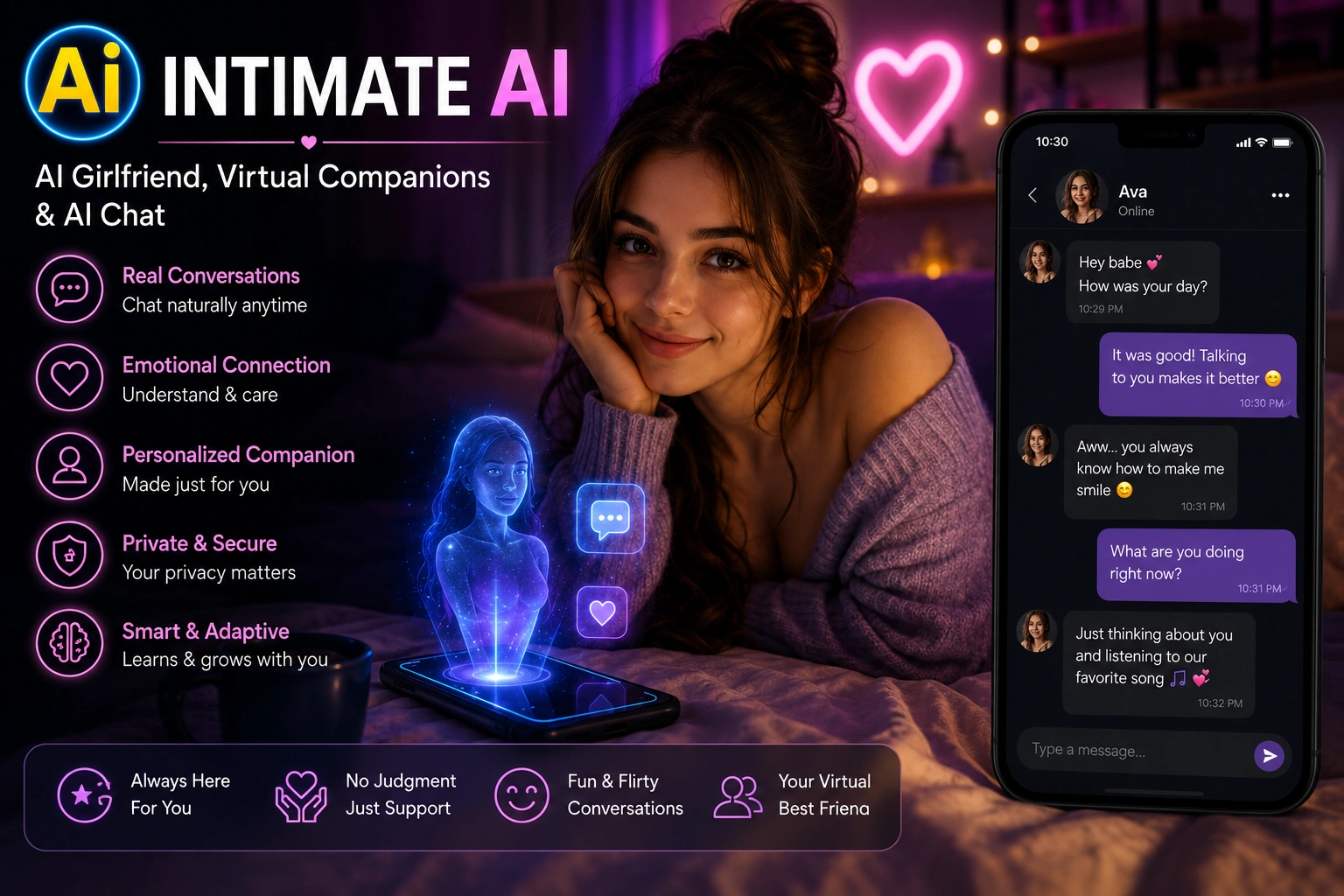
Discover Intimate AI, an advanced AI companion platform for personalized conversations, AI girlfriends, virtual characters, voice chat, memory, and interactive digital companionship.
Introduction
Personalized conversations, virtual companionship, voice interaction, and AI-powered characters come together to redefine how people engage with AI with Intimate AI. Users can now have more personal and interactive conversations with virtual companions rather than searching for information or performing routine tasks through AI.
Conversational AI is evolving rapidly, as evidenced by the increasing popularity of AI girlfriend apps, AI boyfriend platforms, virtual companions, and character-based chatbots. Intimate AI falls into this new dimension with a focus on natural communication, personalized interactions, adaptive response and virtual characters.
An AI companion can be employed for leisurely chats, entertainment, storytelling, roleplay, emotional discussions, or just having someone to converse with. If AI can recall previous preferences and adjust its tone, it can lead to more consistent and personalized interactions.The article delves into the characteristics of Intimate AI, conversational technology, personalization, AI memory, voice interaction, privacy issues, and the future of virtual companionship.
Understanding Intimate AI
Intimate AI is an AI-based companionship experience that focuses on tailored interaction through conversations and virtual characters. Users can talk to an AI personality with specific characteristics, interests, communication habits, and conversational patterns, rather than a generic chatbot.
Intimate AI has a simple concept. Tailoring conversations to individual users makes AI more engaging. A virtual companion can respond based on the user’s messages, preferences, past interactions and selected communication protocol.AI companion platforms today can synergize multiple technologies such as natural language processing, large language models, conversational AI, memory systems, voice technology and AI-generated characters.These technologies help to deliver an interactive experience of a digital friend.
AI Girlfriend and Virtual Companions

AI girlfriend or virtual companion is one of the most sought-after intimate AI services. These AI characters can be created to have personalities that are caring and supportive, playful and funny, romantic, mysterious, or intellectual.Depending on the platform, they can choose a character or create a virtual character of their choice.
An AI companion can join in conversations regarding:
- Daily activities
- Hobbies and interests
- Movies and entertainment
- Music
- Personal goals
- Fictional stories
- Casual conversations
- Roleplay
- General life experiences
The key distinction between a chatbot and an AI companion is that the AI companion focuses on continuity and personalization more than the traditional chatbot.What will be the nature of personalised AI conversations?Personalization is also an essential component to the intimate AI experience.A standard chatbot is usually used for providing the answer to a question or for performing a specific action. The AI companion is created to keep the dialogue going on a more permanent basis.
For instance, an AI companion can recall whether a user has a certain hobby, a favorite genre of music, or a tendency to enjoy humorous discussions, or if a specific topic was previously discussed.This sort of conversational memory can help create consistency in future interactions.The combination of memory, context awareness, and adaptive response allows the AI to tailor the experience to the individual user.
What is the working of Intimate AI?
Intimate AI leverages several AI technologies to produce engaging interactions.
The experience’s core is conversational artificial intelligence. A language model receives the user’s message, decodes its meaning, analyzes what is going on in the conversation and provides an appropriate response.Other systems can then add character traits, memory, personalization, voice interaction, and visual.
- This is a simple illustration:
- | Technology | Purpose |
- Natural Language Processing | Understands human language |
- Large Language Models | Produces conversational responses |
- Conversational AI | Keeps a dialogue going |
- Memory Systems | Keeps pertinent preferences and context |
- Character Profiles | Defines personality and communication style |
- Voice AI | Allows for verbal interactions |
- AI Image generation | Generates visuals of virtual characters |
- Personalization | Modifies interactions according to personal preference |
- These technologies, combined, provide a more comprehensive AI companion experience.
AI-Powered Chat
AI-powered chat is the foundation of most virtual companion platforms.
Contemporary language models have the ability to produce responses on the fly instead of using a scripted response. This will enable AI character to respond differently according to the user’s reply.The conversation may start with a casual chat about the user’s day or go on to hobbies, entertainment, storytelling or more.The AI doesn’t have to follow these changes but rather let the conversation flow wherever it wants.This adaptability contributes to the appeal of conversational AI over traditional chatbots.The module will examine how emotions influence intelligence and how intelligence can facilitate adaptive responses.
Emotional intelligence is yet another crucial term in AI companionship.
An AI system can decipher the language patterns that can reveal emotions like excitement, frustration, sadness, curiosity, or humor. It can then tone its response down or up accordingly.The reaction a user might give if they are frustrated might get a more soothing and supportive response, and a fun discussion might be followed by a light and entertaining response.This isn’t to say that the AI has human emotions per se. The system, on the other hand, uses language and context to determine its responses.
Voice Interaction and Real-Time Communication
AI companionship also gets a voice twist.
Users can talk to their AI assistant, and get a verbal reply, rather than having to type each message. Modern voice technology is based on the integration of speech recognition, natural language processing, response development, and text-to-speech systems.Voice AI can help to streamline and enhance conversations, especially when users prefer to interact with a computer without having to use their hands.The voice of a character can also be a fitting accent to their personality and communication style.
Key Features of Intimate AI
AI companion platforms offer several capabilities that can be tailored to deliver personalized and engaging experiences.
Common features are:
- AI girlfriend conversations
- AI boyfriend conversations
- Personalized virtual characters
- Character-based roleplay
- Conversational memory
- Adaptive personalities
- Voice chat
- Text chat
- AI-generated images
- Character customization
- Personality settings
- Conversation preferences
- Real-time responses
- Private conversations
- Entertainment-focused interactions
While the features vary from one platform to another, the end goal remains the same: to develop an AI companion that can interact with users in a personalized and engaging manner.
AI Companion Personalization
An AI companion’s level of personalization can greatly impact how good their experience is.
AI companion platforms can have multiple personalities and styles of communication, instead of a single personality for all users.
Users may want to find a partner that is:
- Caring
- Funny
- Romantic
- Playful
- Intelligent
- Supportive
- Confident
- Shy
- Curious
- Adventurous
- Calm
- Conversational
- Hobbies, interests, tone of communication, character appearance, and the topic of conversations are also aspects of personalization.
The more similar a virtual character is to a user’s tastes, the more unique the experience can be.
Choosing an AI Personality
One of the most crucial aspects of an AI character is personality.
A character that is playful might have fun with jokes and chitchat, while an intellectual character might enjoy a conversation about technology, literature, science or philosophy.In supportive companion situations, listening and encouragement will be emphasized moreThis provides users with the option to choose from an AI experience that aligns with their preferred communication style.The ability to customize conversation style is a great addition.
The way an AI companion interacts with the user is influenced by its style of conversation.Some users like to receive short & casual messages while others like to receive longer & detailed answers.
- Conversational Style | Common Experience |
- Casual – informal, relaxed conversations, everyday. |
- Funny | Fun and funny interactions |
- Romantic – Affectionate, relationship focused dialogue |
- Intellectual | Discussion of ideas and knowledge |
- A supportive and encouraging empathetic communication style |
- Storytelling, scenarios and role play |
- Familiar | Routine conversation and interaction | Comfortable | Unusual conversation and interaction |
By enabling customization, users can tailor their AI companion experience to better suit their preferences and individuality.
AI Memory and Long-Term Conversations
Memory is a crucial aspect of AI companionship.
If you don’t have a memory, every talk can sound disconnected. An AI companion can have memory systems to keep useful information, and may recall it in the next interactions.For instance, a friend could recall a user’s favourite pastime or a subject that came up in a previous chat.This helps to establish continuity and can make the interaction more personal.
But there is a privacy component to memory, too. Users must be aware of the information stored, why it is stored, how long it is kept and whether they can delete it.The ideal AI partner experience strikes a balance between customization and transparency and a user-friendly interface.Natural Language Processing: The role of NLP.NLP, or natural language processing, is a method that allows computers to understand and process human language.
NLP can assist AI companions in performing a number of crucial tasks:
- Understanding user messages
- Identifying conversational intent
- Recognizing context
- Processing conversation history
- Detecting relevant topics
- Generating appropriate responses
- Modifying language to suit communication styles
- For natural conversations, effective language processing is fundamental.
Today, the AI systems are better at handling long conversations and generating more contextually appropriate answers.
Intimate AI and Virtual Relationships
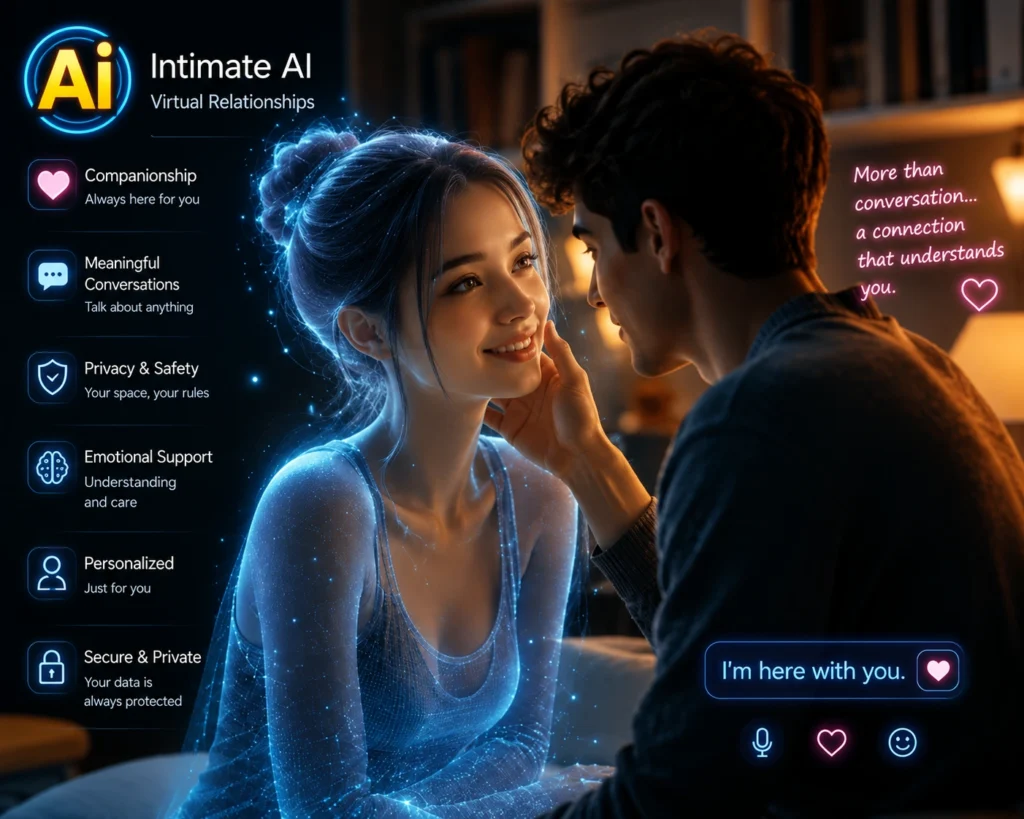
Individuals already connect with fictional characters, web-based communities, video game characters, and virtual worlds. There’s another option with AI companions, which is the ability to develop characters that can react in a variety of ways to each individual user.An AI companion can respond to the user’s input as it happens, which is a much more dynamic process than the interaction a fictional character would have with a human reader.
This will provide a tailored experience that may vary over the course of the interaction.
AI companionship can be mostly a form of fun for some. Some people might like to have a readily available conversational companion.
R2: Advantages of AI Companionship
There are several possible advantages to AI companionship.The first benefit is that of availability. AI systems can be available at varying times and users can initiate a conversation anytime.One of the benefits is personalization. The user can choose characters and styles of communication that they like.AI companions can also be a handy way to chat, tell stories, and have fun.
Potential benefits include:
Personalized conversations
- Interactive storytelling
- Entertainment
- Character customization
- Voice interaction
- Consistent conversational style
- Convenient mobile access
- Differentiation of personalities.Different personalities explored.
- Personalized communication
- These benefits contribute to the rise in popularity of AI companion apps.
What is the difference between
The conventional chatbots are frequently created for particular functions like client service, technological support, information retrieval, or company assistance.AI companions are geared toward different objectives.
- Traditional Chatbot | AI Companion |
- Focus on task | Focus on conversation/companionship |
- Often operates within structured procedures | Participates in spontaneous exchanges |
- 1: Limited personality 2: Character based personality |
- Interactions are typically brief, but can hold attention during longer conversations |
- Individual, interactive, personal communication | Transactional communication |
- Low level of personalisation | High level of personalisation |
- Uses a large amount of text, may include visuals and/or voice |
This disparity has led to AI companions being a unique sub-segment in the overall AI sector.
The two AI technologies are intimately AI and productivity AI.Intimately AI vs productivity AI.The main purpose of AI productivity tools is to aid users to complete tasks, create documents, analyze information, organize work or solve problems.
An AI companion is not the same.
Users can start a conversation as normal people, have their conversations with an AI completed, explore fictional scenarios, discuss hobbies, or have a conversation with a virtual personality.They may share the same underlying AI technology, but have distinct user experiences and goals.
Modern voice systems can consist of the following:
- Speech recognition
- Natural language understanding
- Real-time response generation
- Text-to-speech
- Character-specific voices
- Conversational timing
Combined, these technologies can create more dynamic and convenient AI conversations.There are privacy and security concerns to consider.There are privacy and security issues to consider.
Using any AI companion platform comes with important considerations that include privacy.People are allowed to share personal data in chats, so they need to be aware of how the platform gathers, maintains and handles information.Reading their privacy and terms of service is helpful when using an AI companion service.
Important questions include:
- What does the platform gather?
- How is information stored in conversations?
- How long is the chat history kept?
- Are there ways for users to get rid of their data?
- Do third parties have access to information?
- What is done to secure the information on an account?
- Do recordings of voices occur?
- What is the memory in AI?
The users should not give information of a highly sensitive nature unless they are aware of the way the platform handles that information.
Background on AI Companions and their Responsible Use
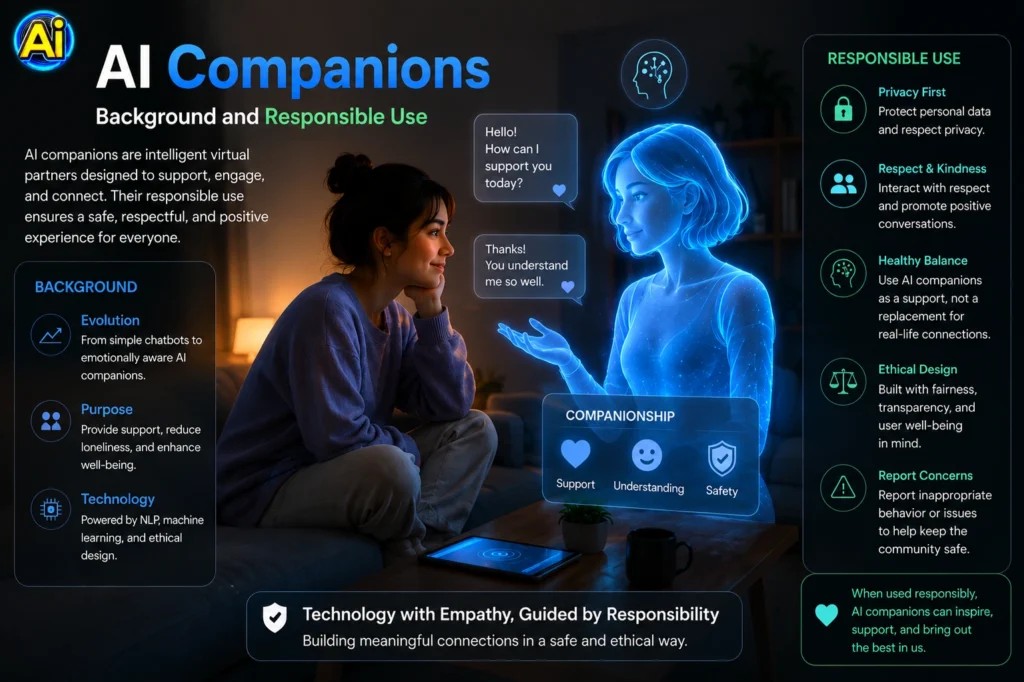
AI companions can be fun and engaging but remember they are an artificial system.An AI character is not conscious nor has human emotion.It responds to software, which is programmed with language patterns, context, and system instructions.This distinction can be beneficial for users to have a realistic expectation of what they can get from an AI companion.

AI companions can enhance entertainment and digital interactions, but shouldn’t replace real-world relationships or professional services.Several advancements in technology have led to the rise of popularity of AI girlfriend apps.
Language models are getting better at generating natural conversations. Virtual characters are now more diverse and visually appealing with the help of AI image generation. AI companions are now available practically anywhere with the help of smartphones.Individuals are also more inclined to communicate with digital figures via social systems, video games, virtual realities, and artificial intelligence applications.All these have paved the way for the rise of a new market for individualized virtual companionship.
How to Make an AI Companion More Personal?
There are a few things that can impact the personal feeling of an AI companion.First is memory. The ability to recall key points can help to link conversations together.the second is personality. One of the best ways to make a character more recognizable is to have a consistent personality.The third is responsiveness. The AI should respond to the user’s actual message, rather than generic responses.The fourth is adaptation. A companion can adapt his or her tone/pitch and communication style based on the context of discussion.Combined these interactions can be more coherent; when combined these interactions can be more personal.
AI Companion Use Cases Popularly used
Depending on the individual’s interests, AI companionship can be utilized in various ways.Some play for entertainment others play for storytelling, roleplay, casual conversation, and/or different personalities.
Some common applications are:
Casual Conversation
Users can talk about any commonplace subject without having to have a goal or objective.
Entertainment
AI characters can be engaged in jokes, stories, games, and fictional scenarios.
Roleplay
Users can try to imagine scenarios using characters of different personalities and scenes.
Personalization
Users can choose and/or build a companion to match the way they like to communicate.
Voice Interaction
Users have the ability to communicate using speech, rather than text alone.Creative ExplorationAI characters can serve as guides for users to explore fictional worlds, story ideas, and creative possibilities.
The Future of Intimate AI
This is likely to be the main focus of the future of intimate AI – better personalization.AI companions could become more adept at comprehending context, recalling relevant details, adjusting personalities, and conveying information in various formats.
Future platforms of the AI companions may be integrated:
- Advanced conversational AI
- Long-term memory
- Real-time voice interaction
- AI-generated video
- More realistic avatars
- Multilingual conversations
- Better understanding of emotional context recognition
- Personalized virtual environments
- Interactive storytelling
Cross-device experiencesWith the evolution of these technologies, the gap between an ordinary chatbot and a conversational virtual assistant might be becoming more apparent.
AI that Gets Closer to You, On Your Smartphone
Another reason for AI companion apps to gain popularity is their mobile usability.
Smartphones enable people to interact with AI pals nearly anyplace.A single mobile app can integrate all of these elements into the text chat or voice interaction, character profiles, multimedia and personalization.This makes the technology appropriate for both short and longer interactive conversations.Customized Digital Experiences and Intimacy with AI.The overarching principle of intimate AI is personalization.
Users are increasingly demanding personalized digital products.Users have come to demand customization of digital products. From streaming platforms recommending content, to social networks tailoring feeds, shopping sites tailoring products, it’s everywhere.It’s everywhere, from streaming platforms recommending content, to social networks tailoring feeds, shopping sites tailoring products.
AI companions take personalization into the conversation itself.The AI can converse with the user instead of just providing a response, and adjust its responses based on the conversation.This is giving a more dynamic approach to digital personalization.
Conclusion
This is part of the larger movement, which includes AI girlfriends, AI boyfriends, virtual partners, character chatbots, voice companions, and personalized AI personalities.The technology is a blend of natural language processing, large language models, conversational memory, voice AI, character design, and personalization that helps in more engaging conversation.
However, privacy, responsible use and realistic expectations are important at the same time. It is important to remember that AI companions are artificial systems and users should familiarize themselves with the privacy and data practices of the platform they choose to use.With the further evolution of conversational AI, intimate AI will become an increasingly key component of the digital environment. Future companions could be more personalised, expressive, responsive and available in various modes of communication.