
Deep Agent AI, how do they work, and why are they important for complex, long running, AI tasks. Delve into the concepts of planning, memory, subagents, orchestration, security, evaluation, and real world examples.
Introduction
AI is transitioning from question answering systems. Today’s AI agents can browse the internet, operate software applications, read files, interact with APIs, process data, and perform tasks for a user.However, one action is quite different from managing an entire project.Suppose you ask an artificial intelligence to find out the cost of a smartphone. This may need some search ability and a brief answer. Now change the request:Research 20 smartphone competitors, compare prices and specs, review customer feedback, find gaps in the market, validate key claims, and develop the Business Report with recommendations.
It’s not just a question and answer exercise. The system must determine what information it requires, form a plan, partition the work, employ multiple tools, record intermediate results, monitor the context, review results, handle failures, and ultimately construct a coherent answer.That’s where Deep Agents come in handy.Deep Agents are AI agent systems that are created to handle long-running, complicated, multi-step work. These generally include explicit planning, tool use, long-term memory, context handling, domain-specific skills and subagent delegation. NVIDIA refers to the four core concepts of deep agents: explicit planning, hierarchical delegation, permanent memory and specialized system instructions or skills.
What is the mechanism behind the working of “deep agent” architecture?
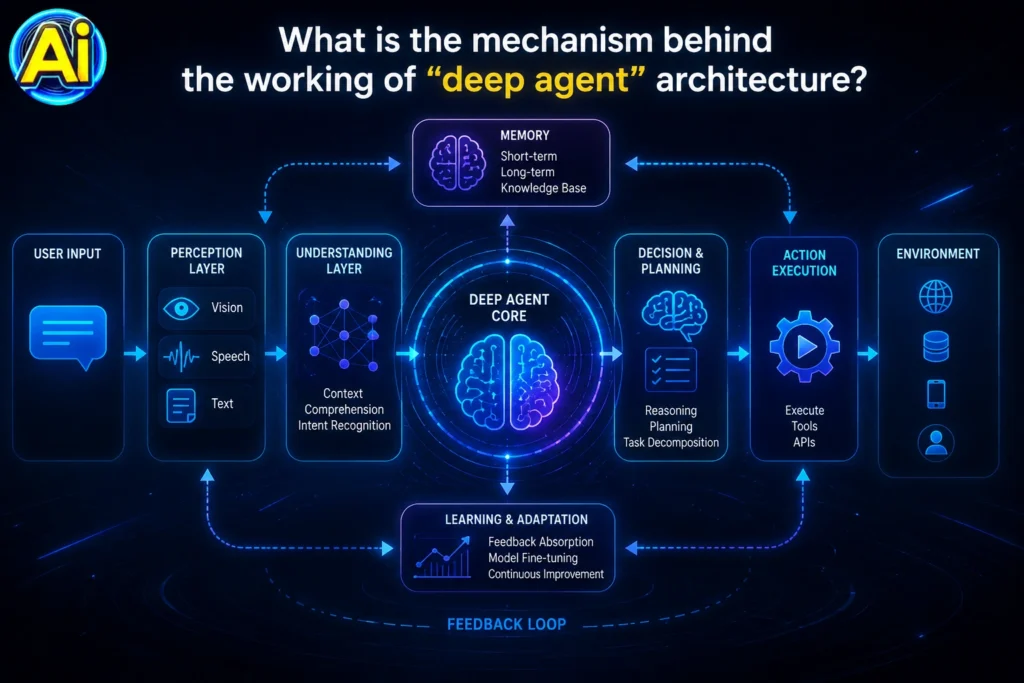
The simplified Deep Agent architecture is represented as:
- User Goal
- ↓
- Agent Orchestrator
- ↓
- Planning & Task Decomposition
- ↓
- Specialized Subagents
- ↓
- Tools & External Systems
- ↓
- Persistent Memory / Shared Workspace
- ↓
- Verification & Evaluation
- ↓
- Final Result
- The different layers are responsible for different tasks.
The orchestrator maintains the overall objective. Planning takes that vision and breaks it down into achievable actions. Subagents are engaged for specific tasks. The tools relate the system to outside information and programs. Memory holds information that is useful but not for the here and now. Verification is a procedure that checks significant outputs at an interim stage in the process.This architecture prevents one model context from having to hold all the details of a long running task, and it is more conducive to separating planning from execution.Also visit my other post ChatGPT Free No Limits
Explicit planning and task decomposition To The Deep Agent AI
One of the most crucial traits of Deep Agents is their planning ability.The system can generate a task plan for solving a large objective, rather than asking the model to do it in one continuous process.
If you are requesting software development, for instance:
- Understand the requirements.
- Check the existing repository.
- Identify affected components.
- Review dependencies.
- Make a plan for how you’ll implement this change.
- Edit the required file(s).
- Run tests.
- Investigate failures.
- Fix problems.
- Perform final verification.
As more information becomes available, the plan can be modified.If the agent finds the current architecture differs in some way from what they’ve been expecting, they can change the task plan rather than assuming the wrong one.Explicit planning is the ability to have a task list or working state that can be looked at and modified as work is done, including marking tasks as done or blocked out.Perfect reasoning doesn’t always result from planning. It is useful for providing a long running workflow structure.
An agent can easily:
- forget to complete unfinished tasks
- repeat work
- overlook dependencies
- Take too long on unproductive activities
- get off track from the initial goal
- Have trouble recuperating after a failure in approach
- Progress tracking is helpful for task automation that is more complex.
Agent Orchestration & Subagents
The AI agent orchestrator is the project manager, or the person managing the process.It doesn’t do anything automatically, but it makes decisions about what work needs to be carried out and who should do it.
A competitive research workflow could look like:
- Main Agent
- → Research Agent
- → Data Analysis Agent
- → Customer Review Agent
- → Verification Agent
- → Report Writing Agent
- A specific piece of responsibility is given to each subagent.
- For instance, a research agent can be used to explore public sources, a data agent to analyze structured information. The important claims are checked by a verification agent before the final report is created.
A subagent is then a specific AI agent that performs tasks in a larger AI agent process.
One of the reasons why LangChain’s Deep Agents architecture focuses on subagents is that they offer context isolation. When many details are involved, a specialist employee can handle all the details, returning a helpful summary to the main agent.
This is especially helpful if the task requires a lot of information.
Parallel Agents and Agent Collaboration
It is possible to complete some tasks on their own.If an organization is interested in research for 10 competitors, then it is interested in 10-minute research. The orchestrator could give several workers independent research tasks to work on, rather than processing each competitor in turn:
- Orchestrator
- → Competitor 1
- → Competitor 2
- → Competitor 3
- → Competitor 4
- → Competitor 5
- → …
- → Competitor 10
- The results can subsequently be passed on to an analysis agent for comparison.
Parallel execution brings out the benefits of decreased total completion time but has the downside of increased compute usage and system complexity. It should therefore be used in situations where the work is truly independent.The aim is not to generate as many agents as possible. The aim is significant specialization.
Persistent Memory and External Storage
Eventually, it comes to a context problem for long-running AI agents.Now imagine an agent that is able to do all four of those actions at the same time, while reading documents, making queries on databases, reading customer feedback and checking APIs and storing decisions.The working context may get crowded and complex if all the information stays in the local context.Deep Agents are the solution to this problem by externalizing information.
Rather than have the model store all of the information, the system can hold a workspace of files like:
- project-plan.md
- research-notes.md
- sources.md
- decisions.md
- test-results.md
- open-issues.md
- The agent will have access to relevant information as needed.
- This is more of a knowing where information is stored, than remembering it all.
Persistent memory is one of the fundamental building blocks of deep-agent architecture, according to NVIDIA. Additionally, LangChain’s implementation takes advantage of the filesystem capabilities for storing and retrieving information in long-running tasks.
Context Management
Persistent storage is just a partial solution. The agent needs to also choose what to include in its active context.This is what context management is.An agent may have to:summarize older interactionsremove irrelevant informationUse the offload large tool for large tools. Look for information when necessary .isolatesubagent contexts preserve important decisions.Focus on information that is relevant to the taskLangChain explains context compression as a process of discarding information from the working memory while retaining information that would be relevant to the task. It can generate large tool results, compress old data, and manage the files instead of storing the entire history of the tool in the active context using its Deep Agents tooling.

The principle is simple:Sometimes MORE is not better.If there is nothing of interest in the middle of irrelevant information, the model will not be able to filter it out.
Tools and External Systems
AI agents use tools to communicate with the outside world.
An agent that is deep may employ:
- Web search
- Databases
- APIs
- Browsers
- File systems
- Code execution
- Cloud services
- CRM platforms
- Internal knowledge bases
- Business applications
Not all external actions are performed directly in the language model. Rather, it determines when to use a tool and what its input should be.This is where the importance of tool design comes in.A tool should have clear inputs, predictable outputs, have an appropriate level of permissions and should be protected from unauthorized use. The more powerful a tool is, the less authority should be given to the agent who is in charge of it.
Specialized Skills
Another concept of importance is agent skills.A skill may be instructions, procedures or knowledge that can be re-used for a specific kind of work.
Examples of skills that an organisation can develop are:
- SQL analysis
- financial reporting
- software testing
- security review
- customer support
- market research
- technical writing
- Instead of attempting to include all instructions into one giant system prompt, capabilities can be provided when they are appropriate.
- This allows for more modular architecture and can boost context efficiency.
Deep Agents vs ReAct Agents
ReAct is a significant step in the foundation of agentic AI. he original ReAct research presented a technique to mix reasoning and acting in the same LLM, enabling it to reason about what it should do, take some action, see the outcome, and repeat the process.
Simplified ReAct loop is:
- Reason → Act → Observe → Reason → Act
- This is good for most situations involving tools.
- Deep Agents should not be considered a substitute for ReAct.
- ReAct can be embedded within a broader system, however:
- Long-Term Goal
- ↓
- Plan
- ↓
- Subtask
- ↓
- ReAct Execution
- ↓
- Result
- ↓
- Memory
- ↓
- Next Subtask
- It’s a construction difference.
- The ReAct approach explains reasoning and acting on executing an agent. Deep Agent architecture brings in higher level planning, delegation, memory, context management, and long running workflows.
Deep Agents vs RAG
Retrieval-Augmented Generation (RAG) is a knowledge-retrieval method that has been very recently proposed.The classic RAG approach adapts a language model with an external non-parametric memory to allow for retrieval instead of relying solely on knowledge embedded in model parameters.
A simple RAG process is:
Question → Retrieve Information → Generate Answer
A Deep Agent can be used as a part of a larger workflow, and RAG can be used as one of its parts:
- Information Gap Task: Question Plan Identify Information Gaps Retrieve Analyze Retrieve More Verify Answer
- Thus, Deep Agents and RAG are not mutually exclusive.
- RAG is used to help an AI system gather relevant knowledge. A Deep Agent offers wider architecture for managing a complex work.
- A Deep Agent can use RAG in conjunction with web-search, database, semantic search, APIs, or internal knowledge bases.
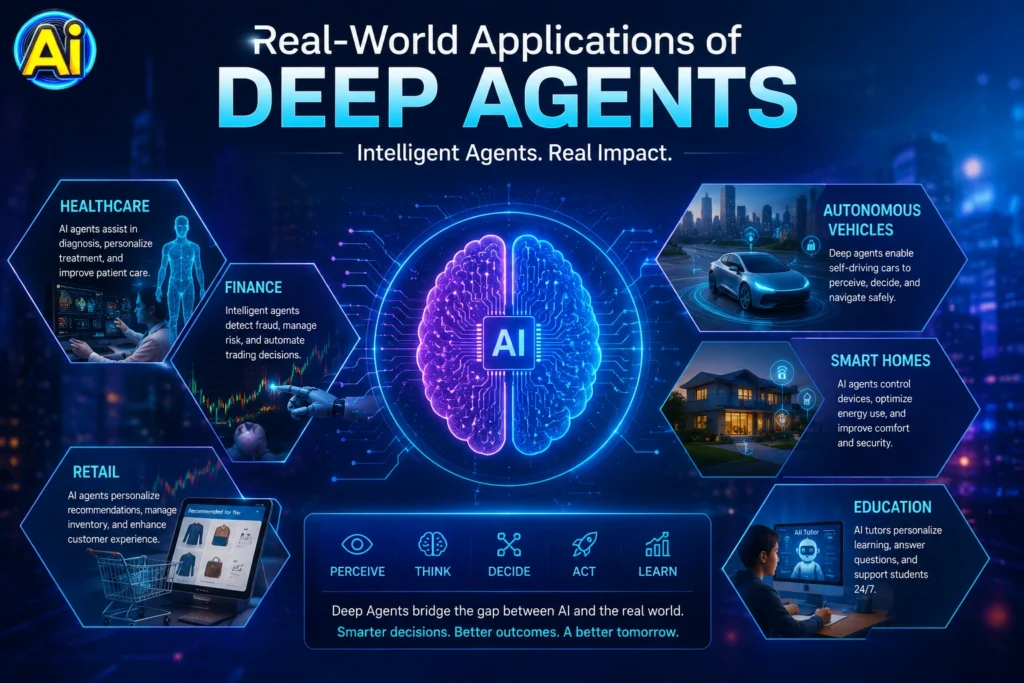
Real-World applications of Deep Agents
AI Coding Agents
Long-running AI agents are particularly suitable for software development.
A big coding project can consist of:
- Repository exploration
- Architecture analysis
- Dependency inspection
- Task planning
- Code generation
- Multi-file refactoring
- Testing
- Debugging
- Security review
- Final verification
- This is a much more different concept from asking the AI to create a single function.
- The agent must be familiar with the current code base, make modifications, execute tests, diagnose failures, and possibly rewrite the agent.
- NVIDIA considers modern coding agents as workflows that include planning, subagents, accessing the file system, and long-running execution.
Deep Research Agents
Another natural application is deep research.
A research agent may:
- State the research problem.
- Divide into questions.
- Search multiple sources.
- Delegate specialized research.
- Compare evidence.
- Identify information gaps.
- Store important findings.
- Verify significant claims.
- Write a well-organized report.
- This can help with market research, competitive intelligence, industry analysis, academic research, technology research, and compliance investigations.
- It’s not just about the speed of search. It’s handling the whole research process.
Enterprise Search
Often, organizations have to keep data in lots of systems:
- PDFs
- databases
- wikis
- cloud storage
- CRM systems
- support tickets
- analytics platforms
- internal reports
- Documents can be returned by a traditional search engine. A Deep Agent can be used to research a broader question from various sources.
- For example:
- What caused the rise in churn for the quarter?
The agent may look through support tickets, CRM information, product analytics, sales notes, customer surveys, and internal data to generate an explanation.This makes enterprise search more of an investigation, than it is a tool for document retrieval.
Computer-Use Agents
Computer-use agents can browse Web pages, click on controls, type text, complete forms, and utilize desktop applications.This can be useful if none of the applications you are aware of offers an API for this purpose.Human interaction conditions the potential impact of errors, but computer interaction can also increase that potential. Restricted permissions, sandboxed environments, action validation, monitoring, and when appropriate, human approval, should therefore be used for sensitive workflows.
Business Process Automation
Deep Agents can also be used to support complex business workflows.
For example:
- Customer Complaint
- ↓
- Identify Customer
- ↓
- Retrieve Account Information
- ↓
- Review Policy
- ↓
- Analyze Issue
- ↓
- Determine Response
- ↓
- Update CRM
- ↓
- Send Response
- ↓
- Escalate if Necessary
- If all the steps are foreseeable, traditional workflow automation might be easier.
The usefulness of an agent becomes more valuable if the process is ambiguous and model-based decision making is necessary.
Benefits of Deep Agents
In the case of the actual need, Deep Agent architecture can offer several benefits.
- Improved assistance for long tasks: More complex tasks can be broken down into several steps.
- Better task structure: Explicit planning offers progress monitoring and better execution of tasks.
- The pressure on the active context window is eased by better context management: External storage and context isolation.
- Specialized work: Subagents and skills enable the use of specific functions in different portions of the workflow.
- Adaptive execution: The agent is able to adjust its actions in response to new information or failure.
- Independent tasks: There are times when tasks can be carried out independently at the same time.
- More automation: The system can also control various processes, rather than just one single process.
- Reusable capabilities: Tools, skills, prompts and subagent configurations can be re-used in other workflows.
- These advantages are, however, at a price.
Limitations and Disadvantages
There is no guarantee that Deep Agents will always perform better than simpler AI systems.
The disadvantages of the main include:
- Higher Cost
- The more model calls, tool calls, and subagents, the more compute and API costs will rise.
- Higher Latency
- This is a more complex workflow that can take a lot longer than a direct model response.
- More Failure Points
- Each API, tool, subagent, database and external service adds another potential failure point.
- Harder Debugging
- Developers should be familiar with the entire agent journey and not just one response.
- Security Risks
- An agent that has access to files, databases, APIs, browsers or code execution has a much bigger attack surface.
- Evaluation Difficulty
- A final answer might be correct, but the process used was not efficient, safe, or cost effective.
This is the reason why agent architecture must be aligned in accordance to the complexity of the actual problem. The principles of Anthropic’s guiding are building simple, composable architectures and only adding complexity where it adds value.
Securing and Guardrails for Deep Agents
The more independent an agent is, the more significant the security is.A production Deep Agent can be able to execute code, read files, modify documents, access databases, call APIs, browse websites, or send a message.This calls for robust controls.
Least Privilege
Only assign permissions to each agent as needed.A research agent should have read access to approved sources, but should NOT have delete access to production data.
Role-Based Access Control
Permissions may vary between different agents:
- Agent
- Appropriate Access
- Research Agent
- Approved research sources
- Data Agent
- Read-only analytics
- Coding Agent
- Development repository
- Support Agent
- Customer-support system
- Deployment Agent
- Restricted deployment tools
Sandboxed Execution
Whenever agents run code they should do it in a controlled environment.NVIDIA emphasizes sandboxing and operating system level isolation in case of code execution and filesystem access and subprocesses.
Human-in-the-Loop
Certain actions should need human consent, particularly:
- financial transactions
- production deployments
- deleting important data
- changing permissions
- publishing sensitive information
- sending high-impact communications
- The goal is not to take away independence. It is to set proper boundaries to autonomy.
The evaluation and monitoring of deep agents
Typical AI evaluation is looking at the end answer.However, for more complex agentic systems, this is not sufficient.A poor selection of tools, a poor plan, weak evidence retrieval, permission violations, repeat actions and too many resources can all make an agent a failure.Useful AI agent evaluation metrics can include:Task completion ratefinal-answer accuracytool-selection accuracytool-argument accuracysource qualityerror recovery ratehuman intervention rateThe amounts are based on the number of tasks completed.Time to completion policy violations unnecessary tool callsThe right metrics will vary based on the actual purpose of the application.
Agent Observability
Observability enables one to know what occurred in the run.
The ideal production system includes visibility of the following:
- Tools called
- Tool arguments
- Subagents selected
- Tasks created
- Execution time
- Errors
- Retrieved information
- Plan changes
- Human approvals
- Final outcomes
- Cost
- Instead of asking:
- What is the error in the AI’s answer?
- You can ask:
- What did go wrong in the workflow?
- That would be a much more practical question.
Eval-Driven Development
Evaluations should take place in the development, not deployment, phase.
A useful cycle is:
Build – Test – Trace – Identify Failure – Improve – Test Again
A research agent can check the quality of the source, whether the information is factual, whether it has been cited properly and whether there are claims in the source that have not been backed up.dsdAn evaluation for a coding agent might include code quality, security issues, regression rate, correct files changed, and tests passed.This method can be used to optimize the entire agent path, not just the last response.
Some frequent pitfalls in deep agent construction
The most common error is to make everything multi-agent.Not all problems have to be handled by specialists. In some instances it is better to have one agent with solid instruments.
Other typical errors are:Allowing the agent too much freedom of action.The fact that memory was used to store all the intermediate resultsignoring failure recoveryskipping evaluationproviding excessive permissionsOptimizing for number of agents instead of task successOvercomplicating without understanding the processIt’s not the most complicated architecture that makes a good Deep Agent.It is characterized by its reliability in achieving the desired task.
When Should You Use Deep Agents?
Deep Agents are best suited for tasks that have some of these qualities:many steps long execution time multiple tools multiple information sources open-ended objectives specialized subtasks persistent state unpredictable decisions meaningful error recovery parallelizable work Good examples include:deep researchsoftware engineering competitive intelligenceenterprise investigations complex data analysiscomputer-use workflow smulti-stage business automation
It is likely that you do not require a Deep Agent for:
- simple summarization
- basic classification
- straightforward extraction
- fixed data transformation
- simple question answering
- predictable API calls
- basic document retrieval
- When a problem can be solved with a deterministic workflow reliably, it may cost less, be faster, and be easier to maintain.
This is how you can construct a deep agent
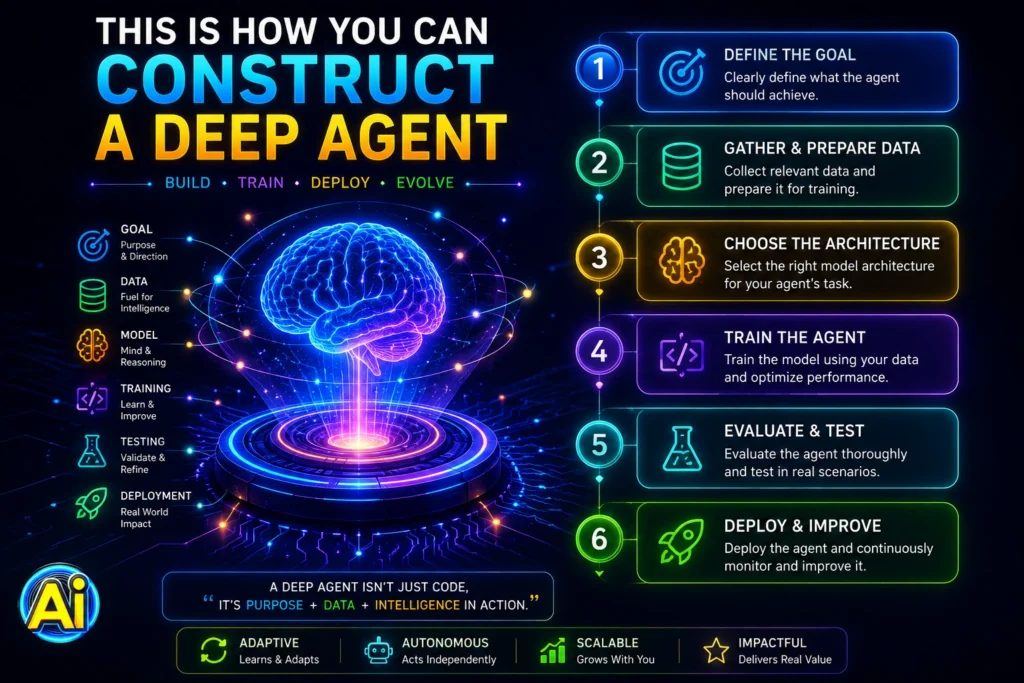
The best route to take is to keep the workflow simple, and only implement additional capabilities when necessary.
Outline the desired outcome.
Step 1: State the goal
Clearly describe what successful completion means.
Step 2: Map the Workflow
Identify:
- Inputs
- Tasks
- Dependencies
- Tools
- Outputs
- Failure points
- Take one agent and begin.
Step 3: Start with one agent
Try using one reliable agent and a few reliable tools first.
Step 4: Add Planning
Use task decomposition and progress tracking when it becomes hard to manage the workflow.
Step 5: Add External Memory
When an information requirement persists outside of the current context, use files, databases or other appropriate storage mechanism.
Step 6:Improve Context Management
Seek out only relevant information in the working context or access other information as needed.
Step 7: Add Subagents
Only introduce specialised agents where it is a real advantage to do so through delegation.
Step 8: Add Verification
Review critical outputs, sources, calculations, code modifications, and high impact actions.
Step 9:Configure Security Controls
Follow the principles of least privilege, authentication, authorization, sandboxing, network restrictions, credential controls and human approval as appropriate.
Step 10: Evaluate Continuously
Keep track of actual workflows and rely on failed ones as testing instances for improvement.This approach of incremental development is used to prevent the construction of a complex system before the requirements are known.
The Future of Deep Agents
Traditional Q&A systems are shifting from answering questions to handling tasks increasingly.
The next generation of agentic systems will probably be a mixture of:
- advanced reasoning models
- persistent memory
- specialized skills
- external tools
- computer-use capabilities
- multi-agent collaboration
- real-time information retrieval
- automated evaluation
- human oversight
This direction is already illustrated in existing Deep Agents tooling. For instance, LangChain is still developing its ability to handle long-running workflows, context management, subagents and asynchronous execution.This goes beyond simply improving models, the future of agentic AI will also hinge on improved architecture, context engineering, security, evaluation, and governance.
Conclusion
Deep Agents are a significant advancement in agentic AI, as they tackle a key challenge for simple AI systems: managing complex work over time.Deep Agent architecture can transform a massive objective into a workflow that may involve planning, splitting the task, executing tools, maintaining persistent memory, managing context, using specialized skills, subagents, verification, and error recovery.This is very helpful for deep research, software development, enterprise search, competitive intelligence, complex data analysis, computer-use automation and multi-stage Business Workflows.
However, deeper architecture isn’t necessarily good.MultiAgent systems are not required for a simple question. Autonomous planning is not required for a predictable API workflow. Also, if retrieval is the only true need, then a reliable RAG system might be better than an agent.
Thus the foremost rule is:
Keep the design as simple as possible that will be able to solve the problem and then add the depth when it is necessary in the workflow.If Deep Agents are truly suitable, such a combination of planning, orchestration, long-term memory, optimization of context, tools and verification can transform an AI model from a response generator into a system that can handle large-scale scale long-term goals.And as these systems grow more independent, the proverb applies: “You can’t keep everything under control. The principles of least privilege, sandboxed execution, access controls, observability, continuous evaluation and human oversight will be as critical as the intelligence of the underlying model.
FAQs: Related To Deep Agents AI
1.What do you mean by Deep Agents?
Deep Agents are AI agent systems that are intended for long running, multi-step, complex tasks. They usually involve planning, breaking down the task, tools, memory, context management, the use of specific skills and delegation.
2.How do Deep Agents work?
A Deep Agent typically has a goal at the top level, then has a plan, then breaks the goal down into tasks, then employs some tools, and maybe some subagents, too, and keeps important information available off-board, and monitors progress, and validates results, and adjusts plan when things go wrong.
3.The difference between an AI Agent and a deep agent is?
An AI agent is a generalized agent that can utilize tools and act. A Deep Agent is a type of agent intended for more stringent applications requiring long-term planning, persistent memory, context management, delegation, and recovery.
4.Is there distinction between Deep Agents and Multi Agent Systems?
No. A Deep Agent may have several subagents but not necessarily. Even a single agent design can be a deep agent design, as long as it incorporates long-running execution, tools, skills, planning, and external memory.
5.Are Deep Agents a cost?
They can be. Planning and model calls, use of tools and subagents can lead to higher costs and time delays. These costs can be controlled with good context management, selective delegation, with the right tools, cache and selecting the right model.