
Meta Description: Deep agent AI is reshaping automation in 2025 by enabling autonomous, goal-driven systems that plan, act, and learn. Discover how it works, real use cases, benefits, challenges, and future trends in this in-depth guide.
Introduction:
Deep agent AI is emerging as one of the most powerful advancements in modern artificial intelligence, changing how systems think, plan, and act independently. Unlike traditional chatbots, deep agent AI is designed to handle complex tasks through reasoning, execution, and continuous learning. It brings together autonomous AI agents, multi-step reasoning, and intelligent automation to perform real-world actions with minimal human input.
By combining large language models with tools, memory, and decision-making capabilities, deep agent AI enables faster workflows, reduced manual effort, and smarter outcomes. As industries move toward scalable automation, this technology is becoming essential for developers, enterprises, and AI-driven operations.
What Is Deep Agent AI?
At its core, deep agent AI refers to an autonomous artificial intelligence system designed to achieve goals through reasoning, planning, tool usage, and reflection. Unlike traditional AI models that return a single response, these agents operate across multiple steps.
How It’s Different from Traditional AI
Traditional AI models are reactive. You ask a question, and they respond. Once the response is delivered, the process ends.
Deep agent AI is proactive. It can:
- Break a goal into smaller tasks
- Decide which tools to use
- Execute those tasks in the correct order
- Evaluate results and fix mistakes
- Store memory for future improvements
This shift turns AI from a passive tool into an active system.
A Simple Example
If you ask a chatbot to explain how to deploy a web app, it gives instructions.
If you ask a deep agent AI to deploy a web app, it can:
- Set up the repository
- Configure the server
- Install dependencies
- Deploy the application
- Confirm that everything is working
That difference is why this technology matters.
Core Components of Deep Agent AI Architecture
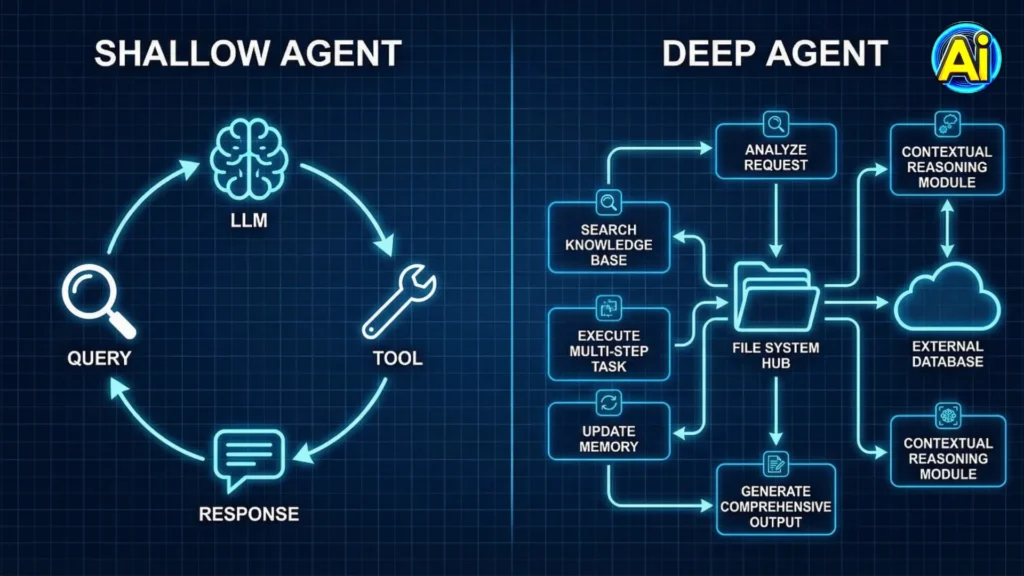
The strength of deep agent AI comes from its architecture. Most systems follow a similar structure, even if the implementation differs.
Planner: Turning Goals into Steps
The planner understands the user’s intent and breaks it down into actionable steps. This includes:
- Identifying sub-tasks
- Prioritizing actions
- Deciding execution order
This planning layer allows the agent to handle complex objectives instead of single commands.
Executor: Taking Action
The executor is responsible for performing tasks. It can interact with:
- APIs
- Databases
- Code interpreters
- Shell commands
- Cloud platforms
This is where deep agent AI moves from thinking to doing.
Memory: Learning from Experience
Memory allows the agent to store:
- Previous actions
- Results
- Errors
- User preferences
Persistent memory makes future runs faster and more accurate.
Reflection: Improving Performance
Reflection helps the agent evaluate its output. If something fails, it can:
- Identify the issue
- Adjust the plan
- Retry with a new strategy
This feedback loop is critical for long-running tasks.
Multi-Agent Collaboration
Many systems use multiple specialized agents, such as:
- Research agents
- Coding agents
- DevOps agents
Together, they function like a small digital team.
Why Deep Agent AI Is So Important in 2025
The demand for automation has exploded. Businesses want systems that save time, reduce errors, and scale without adding staff.
Complexity Is Increasing
Modern workflows involve:
- Multiple tools
- Cloud infrastructure
- Continuous deployment
- Real-time monitoring
Human-only management doesn’t scale well. Deep agent AI fills that gap.
Speed Matters
In competitive markets, speed is everything. Autonomous agents can:
- Work 24/7
- Execute tasks in parallel
- React instantly to issues
This gives teams a real advantage.
Cost Efficiency
By automating repetitive and technical tasks, organizations reduce:
- Manual labor costs
- Downtime
- Human error
Over time, these savings add up.
Real-World Use Cases of Deep Agent AI
Deep agent AI is not theoretical. It’s already being used across industries.
Software Development Automation
Developers use agents to:
- Generate boilerplate code
- Run tests
- Fix bugs
- Deploy applications
This shortens development cycles and reduces developer burnout. Tools like GitHub Copilot and autonomous coding agents are early examples of this trend.
DevOps and Infrastructure Management
In DevOps, agents can:
- Monitor CI/CD pipelines
- Detect failures
- Roll back deployments
- Provision cloud resources
This turns infrastructure into a partially self-managing system. Platforms like Kubernetes and Terraform increasingly integrate with agent-based automation.
Data Analysis and Research
Agents can:
- Collect data from multiple sources
- Clean and analyze datasets
- Generate reports
- Update dashboards
This saves analysts hours of manual work.
Customer Support Operations
Advanced agents handle:
- Ticket classification
- Knowledge base searches
- Automated responses
- Escalation logic
Human teams focus on edge cases instead of routine queries.
Deep Agent AI vs Traditional Automation Tools
Traditional automation relies on fixed rules and scripts. Deep agent AI is adaptive.
Key Differences
| Feature | Traditional Automation | Deep Agent AI |
|---|---|---|
| Flexibility | Low | High |
| Error Recovery | Manual | Automatic |
| Learning | None | Continuous |
| Tool Integration | Limited | Extensive |
| Decision Making | Rule-based | Reasoning-based |
This flexibility is why many organizations are shifting toward agent-based systems.
Popular Frameworks and Platforms Powering Deep Agent AI
Several tools are shaping the ecosystem.
LangChain and Agent Frameworks
LangChain enables developers to:
- Build tool-using agents
- Manage memory
- Orchestrate multi-step workflows
It’s widely used in open-source projects.
Enterprise Platforms
Enterprise solutions focus on:
- Security
- Monitoring
- Scalability
- Compliance
These platforms bring deep agent AI into regulated environments.
Best Practices for Implementing Deep Agent AI
Implementing deep agent AI successfully is not just about choosing the right model or framework. It requires thoughtful design, clear boundaries, and ongoing oversight. When done correctly, deep agent AI can deliver powerful automation. When done poorly, it can create costly and risky outcomes.
Below are the most important best practices to follow.
Start With Clear and Specific Goals
Deep agent AI performs best when it has a clearly defined objective. Vague or overly broad instructions often lead to inefficient planning, unnecessary actions, or incorrect outcomes.
Instead of saying:
“Manage our deployment process.”
Use something like:
“Monitor the CI/CD pipeline, detect failed builds, identify missing dependencies, and retry the build after applying fixes.”
Clear goals help the agent:
- Break tasks into accurate sub-steps
- Choose the right tools
- Avoid unnecessary actions
- Deliver predictable results
The more precise the goal, the more reliable the agent’s behavior.
Limit Permissions and Access
Deep agent AI often interacts with sensitive systems such as cloud infrastructure, databases, APIs, and internal tools. Granting unrestricted access increases security risks.
Follow the principle of least privilege:
- Allow only required API permissions
- Restrict write or delete access unless absolutely necessary
- Separate environments for testing and production
For example, an agent that monitors logs does not need permission to delete cloud resources. Limiting access reduces the risk of accidental damage or misuse.
Use Human Oversight for Critical Tasks
Even advanced deep agent AI systems are not perfect. For high-impact workflows, human-in-the-loop review is essential.
Human oversight is especially important for:
- Production deployments
- Financial transactions
- Security-related changes
- Customer-facing decisions
A common approach is conditional approval, where the agent completes its plan but waits for human confirmation before executing sensitive steps. This balance preserves speed while maintaining control.
Monitor, Log, and Audit Agent Actions
Transparency is critical when working with autonomous systems. Every action taken by a deep agent AI should be logged and traceable.
Effective monitoring includes:
- Detailed execution logs
- Tool usage history
- Error reports
- Decision summaries
These logs help teams:
- Debug failures quickly
- Understand agent behavior
- Improve future performance
- Meet compliance requirements
Without proper logging, diagnosing issues becomes difficult and risky.
Control Costs and Resource Usage
Deep agent AI can consume significant compute resources, especially when running large models or executing long workflows.
To manage costs effectively:
- Set execution limits and timeouts
- Restrict unnecessary recursive loops
- Monitor token usage and API calls
- Schedule non-urgent tasks during low-cost periods
Cost awareness ensures that automation remains sustainable and scalable.
Challenges and Risks to Consider
Despite its advantages, deep agent AI introduces new technical and operational challenges. Understanding these risks helps organizations prepare for them.
Error Propagation
If an early step in a workflow fails or produces incorrect output, later steps may build on that error. This can result in larger failures downstream.
To reduce error propagation:
- Validate outputs at each stage
- Add checkpoints for critical steps
- Use reflection mechanisms to reassess plans
Early detection prevents small issues from becoming major problems.
Security Concerns
Misconfigured agents can accidentally expose credentials, modify infrastructure, or access sensitive data.
Security risks increase when:
- API keys are hardcoded
- Access scopes are too broad
- Logs contain sensitive information
Strong security practices, regular audits, and environment isolation are essential for safe deployment.
Interpretability and Decision Transparency
One of the biggest challenges with deep agent AI is understanding why an agent made a particular decision.
Complex reasoning chains and multi-step planning can be difficult to interpret, especially for non-technical stakeholders.
Improving interpretability involves:
- Recording reasoning steps
- Generating summaries of decisions
Final Thoughts
Deep agent AI represents a meaningful shift in how we build and use intelligent systems. Instead of tools that wait for instructions, we now have agents that can think through problems, take action, and improve over time.This doesn’t replace humans. It amplifies them.As automation grows more complex, systems that combine reasoning, execution, and learning will become essential. Deep agent AI is not a trend. It’s a foundation for the next generation of intelligent automation.
If you’re building, deploying, or managing modern systems in 2025, understanding this technology is no longer optional. It’s a competitive advantage.
FAQS RELATED TO Deep agent AI
Q1. What is deep agent AI?
Deep agent AI is an autonomous system that can plan, execute, and evaluate multi-step tasks. Unlike chatbots, it performs real actions using tools and memory. It is designed for complex workflows and automation.
Q2. How is deep agent AI different from traditional AI?
Traditional AI responds to prompts, while deep agent AI takes initiative and completes tasks end to end. It can reason, use tools, and adapt based on results. This makes it more autonomous and practical.
Q3. Where is deep agent AI commonly used?
Deep agent AI is used in software development, DevOps, data analysis, and business automation. It helps manage deployments, monitor systems, and automate repetitive processes. Enterprises use it to improve speed and efficiency.
Q4. Is deep agent AI safe to use?
Deep agent AI can be safe when proper access control, monitoring, and human oversight are applied. Security risks arise mainly from poor configuration. Responsible implementation is essential for production use.
Q5. What is the future of deep agent AI?
The future of deep agent AI includes multi-agent collaboration and full workflow automation. Agents will act as digital teammates embedded in tools and IDEs. Improved memory and learning will make them more intelligent over time.